
Quick answer: A WD external hard drive that is not showing up usually has one of four problems: a bad cable, port or power adapter, a failed USB bridge board, a corrupted file system, or a fault inside the drive. Check cables, ports and another computer first. If the drive clicks, beeps or stays silent, power it off and get a professional evaluation.
If your WD external hard drive is not showing up, your files are usually still on the platters. What matters now is finding the cause without making it worse. This guide covers My Passport, Elements and My Book drives on Windows and Mac. It explains what is safe to try, what to avoid, and when to stop.
Why is my WD external hard drive not showing up?
A WD external drive disappears when something breaks along the path between the disk and your computer: the cable, the port, the power supply, the USB bridge board, the file system or the drive itself.
Think of it as a chain. The computer only shows the drive if every link works. Here are the usual weak points:
- Cable and port problems. The small USB 3.0 Micro-B connector on many portable models wears out and bends easily.
- Power problems. Desktop models like My Book need their own AC adapter. Portable drives draw power from the USB port, and some ports or hubs can’t supply enough.
- USB bridge failure. The bridge is the small circuit that turns the drive’s signals into USB. If it fails, the drive may spin but never appear.
- File system corruption. Unplugging without ejecting, or a power cut, can damage the file system. The drive then shows up as RAW or asks to be formatted.
- Internal hard drive faults. A failed PCB (the drive’s main circuit board), damaged read/write heads (the tiny arms that read the platters), a seized motor or corrupted firmware can all stop detection.
What should you check first?
Start with simple, non-invasive checks that change nothing on the drive and rule out the easy causes.
- Look at the cable. Check that both ends are fully seated. If the Micro-B plug feels loose, try a known-good cable of the same type.
- Plug straight into the computer. Skip hubs, docks, front-panel ports and extension cables. Use a rear port on a desktop.
- Check the power on desktop models. Use the original adapter and a working wall outlet. Never swap in an adapter with a different voltage. A wrong adapter can burn the board.
- Watch the light. Note whether the LED comes on, blinks or stays dark.
- Listen once. A soft spin-up hum is normal. Clicking, beeping, buzzing or grinding is not.
- Try another computer. If it appears there, the problem is likely your first computer’s port, driver or settings.
If the drive makes an abnormal sound at any point, stop here. Unplug it and skip to the professional help section.
What do the sounds and lights mean?
The drive’s sound and LED are the best clues you have, because they hint at whether the fault is electronic, mechanical or logical.
| Symptom | Likely cause | What to do | What not to do |
|---|---|---|---|
| Light on, normal hum, not detected anywhere | USB bridge fault, cable, or firmware problem | Try one other cable and computer, then seek an evaluation | Don’t open the case or pull the drive out |
| Repeated clicking or ticking | Read/write head failure or damaged platter surface | Power off now and get a professional evaluation | Don’t keep plugging it back in |
| Beeping or buzzing, no spin | Heads stuck to the platters (stiction) or seized motor | Power off and leave it unplugged | Don’t tap, shake or freeze the drive |
| Grinding or scraping | Heads touching the platters | Power off immediately | Don’t retry, even once “to check” |
| No light, no sound | Dead adapter, failed PCB or bridge, power surge damage | Check the outlet and original adapter only | Don’t try random power adapters |
| Detected, but RAW or “format this disk” message | File system corruption | Cancel the prompt and stop writing to it | Don’t format, initialize or run CHKDSK |
How do you check if Windows or macOS sees the drive?
Your computer’s disk tools can tell you whether the hardware is detected, as long as you use them only to look and not to fix.
On Windows
Right-click the Start button and open Disk Management. Look for a disk that matches your drive’s size. Note what it says: healthy with no drive letter, RAW, unallocated or “Not Initialized”.
If Windows pops up an “Initialize Disk” window, click Cancel. Initializing writes a new partition table and can hide your data. Our guide to an external hard drive not showing up in Windows covers these screens in more detail.
On a Mac
Open Disk Utility, then choose View and Show All Devices. A greyed-out entry means the drive is detected but not mounted. You can also check System Information under USB to see if the Mac sees any hardware at all.
Do not click First Aid, Erase or Partition. These tools write to the drive.
A common cross-platform mix-up
Many WD drives come formatted for Windows (NTFS). A Mac can usually read NTFS but not write to it. A drive set up on a Mac with APFS or HFS+ will show in Windows Disk Management, but Windows can’t read it and may offer to format it. That offer is a trap. The data is fine. You just need the original type of computer, not a format.
Why are WD external drives different from other external drives?
Many WD external drives have design features that make do-it-yourself fixes riskier than with an ordinary drive in a generic case.
Hardware encryption on the bridge board. Many My Passport and My Book models encrypt data on the USB bridge, even if you never set a password. If you take the internal drive out and connect it directly, the data may look like noise. If the bridge fails, recovery needs the encryption handled correctly. If you did set a WD Security password, you will still need it.
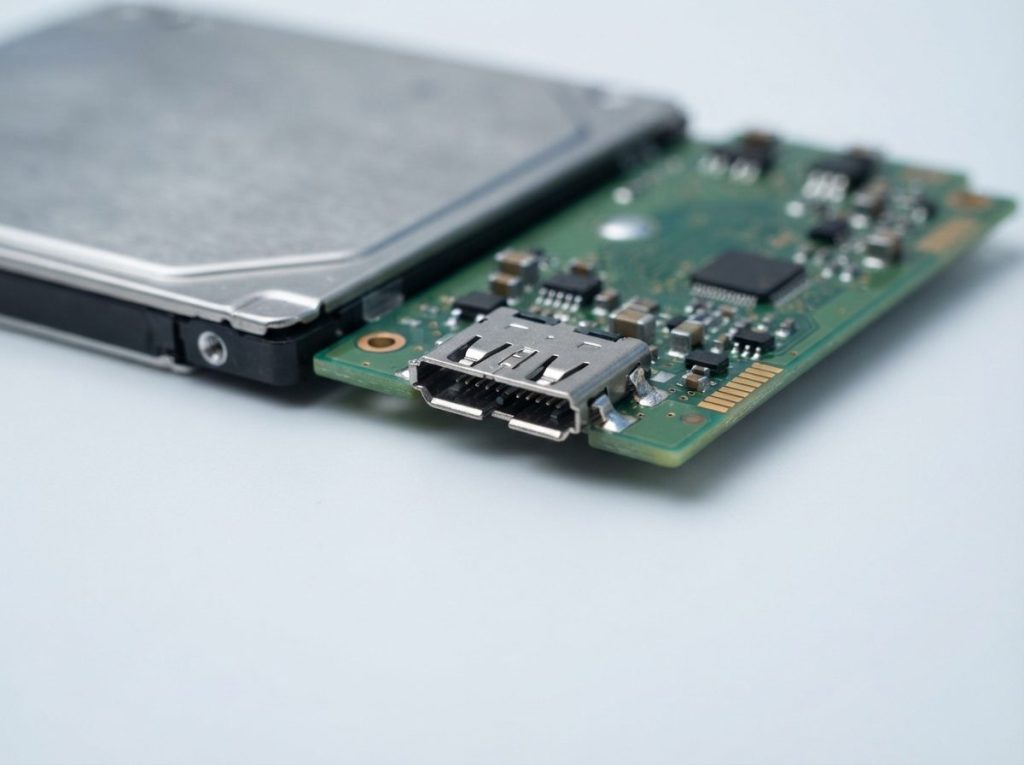
USB built into the drive itself. In many portable models, the USB port is soldered onto the hard drive’s own PCB. There is no standard SATA connector inside. “Shucking” the drive into a new enclosure is not possible, and prying the case open can damage the board.
A fragile connector. A worn or bent Micro-B port can cut the connection on and off. Wiggling the cable while the drive runs can disconnect it mid-read and corrupt the file system.
What should you avoid doing?
The most common cause of permanent loss on an undetected drive is a well-meant “fix” that writes to the disk or stresses damaged parts.
- Formatting or initializing. Both overwrite the structures that point to your files.
- Running CHKDSK, fsck or First Aid. These change the file system and can make corruption worse, especially on a drive with bad sectors (areas that can no longer be read reliably).
- Power-cycling a noisy drive. Each start can scratch the platters further.
- Opening the drive. Dust specks are larger than the gap between head and platter. Opening a drive outside a cleanroom can ruin it for good.
- Swapping circuit boards. Each drive’s PCB holds unique calibration data, the ROM/adaptives. A board from another drive usually won’t work and may cause more damage.
- Trial-and-error recovery software. Read-only recovery tools exist for drives that are detected and sound normal. If the data matters, or the drive shows any physical symptom, stop and get help. Every failed attempt can lower the odds.
- Saving anything new to the drive. New files can overwrite the ones you want back.
Can data be recovered from a WD drive that isn’t detected?
Yes, data is often recoverable from an undetected WD external drive, because the platters usually survive even when electronics, heads or firmware fail. Success depends on the type and extent of the damage, so no one can promise a result before a diagnosis.
At Prime Data Recovery in North York, we follow the same order for every drive:
- Free evaluation and diagnosis. We find out whether the fault is in the bridge, the PCB, the firmware or the mechanics.
- Findings and quote. You approve before any work starts.
- Physical repair if needed. Head work, called a head stack replacement, is done in our ISO certified Class 10 cleanroom with parts from a matching donor drive. Board repairs keep the original ROM/adaptives.
- Controlled imaging. Imaging means copying the drive sector by sector to another disk without writing to the original. A DeepSpar Disk Imager lets us read weak drives gently. PC-3000 tools help diagnose and repair firmware problems, such as a damaged service area (the drive’s hidden firmware zone) or translator (the map that links data locations to physical sectors).
- Recovery and file verification. We rebuild the file system from the image and you review your files in a file verification session before delivery.
- Delivery on a new storage device.
You can read more about each step on our data recovery process page.
When should you get professional help?
Get professional help as soon as the simple checks fail, the drive makes any abnormal sound, or the files are too important to risk.
Use this quick decision guide:
- Works on another computer: Back up your files right away, then sort out the first computer.
- Detected but RAW or asking to format, sounds normal, data not critical: Read-only software may help. Stop at the first error or slowdown.
- Detected but RAW, and the data is important: Leave it unplugged and request an evaluation.
- Not detected anywhere with a new cable: Likely a bridge, PCB or firmware fault. This needs lab tools.
- Clicking, beeping, grinding, burning smell, a drop or water exposure: Power off. Do not retry.
Prime Data Recovery offers external hard drive recovery for WD and other brands. Every drive is handled confidentially and in line with Canadian privacy law (PIPEDA).
Key takeaways
- Most WD drives that stop showing up still have their data on the platters.
- Safe checks are limited to the cable, port, power adapter, disk tools in view-only mode, and another computer.
- Clicking, beeping, grinding or silence means power off and stop.
- Never format, initialize, run CHKDSK or First Aid, or open the drive.
- Many WD drives use bridge-board encryption or built-in USB, so removing the internal drive is not a simple fix.
If your WD drive still won’t show up, Prime Data Recovery can help. Our lab in North York, Toronto, offers a free evaluation, a fast free 30-minute diagnostic and a “No Data, No Fee” policy. Customers across Canada can ship their drives to us. Request your free quote or call (416) 661-1112.
Frequently Asked Questions
Can I take the hard drive out of my WD case and connect it directly?
Usually this is not a good idea. Many portable WD drives have the USB port soldered onto the drive's own circuit board, so there is no standard connector inside. Many models also encrypt data on the bridge board, so a removed drive may show unreadable data. Prying the case open can also crack the board. Have the drive evaluated instead.
Is my WD My Passport encrypted even if I never set a password?
Many My Passport and My Book models encrypt data on the USB bridge board automatically, with or without a password. You won't notice it during normal use. It matters when the bridge fails, because the data has to be read and decrypted in the right way. If you did set a WD Security password, you will still need it for recovery.
Will a warranty replacement get my files back?
Usually not. A manufacturer warranty normally replaces the faulty hardware with a new or refurbished drive, and your original drive and its data are not returned. If the files matter, have the data recovered first, then deal with the warranty. Check your warranty terms before sending anything away.
Why does my WD drive show up on my Mac but not on my Windows PC?
The drive was probably formatted on a Mac with APFS or HFS+, which Windows can't read. Windows may list the disk in Disk Management and even offer to format it. Don't accept. Your data is likely fine. Copy the files using the Mac, or ask a professional for help if the Mac can't read the drive either.
How long can I wait before getting a failing WD drive recovered?
If the drive is unplugged and stored somewhere dry and cool, waiting does not usually make things worse. The damage happens when a failing drive runs. Clicking or grinding drives can lose more data each time they spin up. So the safest choice is to stop using the drive now, then arrange an evaluation when you're ready.
